Generative AI - An existential question for enterprises
The Gen-AI ship has sailed, onboard or be left behind.

Imagine you can do time travel. You buy a ticket to land straight into April 2025.
You used to work for a tech company - I bet you are shocked, hopefully in a pleasant way.
You land into the corporate headquarters of the “Next 2.0", Inc. You have a meeting with their CEO who speaks “German”. Both of you have a miniature microphone attached that translate the communication back and forth. You are presenting a digital prototype of a potential Security solution, which you perfected in your flight using a specific AI platform designed and customized for you & your think-tank.
The digital prototype is a live object that listens to the feedback and propose minor tweaks to the design & scope Realtime.
With me so far?
Your clients is impressed with the ingenuity of your solution and your presentation. Because the earlier guy, is still using PowerPoint. Remember it is still 2025. You submit the scope & pricing with AI backed decision intelligence platform, and hopefully your client approves it too with a build in decision intelligence platform.
You finish the meeting - And on you way out, you approve the AI generated action items with minor tweaks in the elevator with a calendar invite based on client’s schedule.
And, back up, when I say team - I am referring to 2-3 AI power-user who can execute these tasks with 10X efficiency. This was a seven figure deal that took a week to close.
You came back to the hood - Your next upsell, opportunity is created and forecasted for revenues. You ask, your sales co-pilot, what are my next steps to beat my quarter and you get a precise instruction list, because guess what your sales co-pilot can combine forces with sales
Welcome to the Matrix! - except for this is still a reality and not a simulation.
Question is which roles will become super efficient and which ones will be eliminated. May be a discussion topic for another time

Could you have imagined this - I bet you’d have another novel version of these
Isaac Asimov has captivating references of what AI is capable of in his books- Humans are pretty good at Imagination.
"Man is a genius when he is dreaming." Akira Kurosawa
Let's dive into some specific use cases where generative AI is proving to be a game-changer. While there are many organizational use cases spanning from Revenue to cost efficiency to customer experience to employee experiences, I am going to delve deeper into “ all things revenues” given my personal Ikigai.
Let’s call our end state - “stage 5” in a five step process - You poor human, you can’t think exponentially .

I have pulled together few stickies and mental models to make it clear.
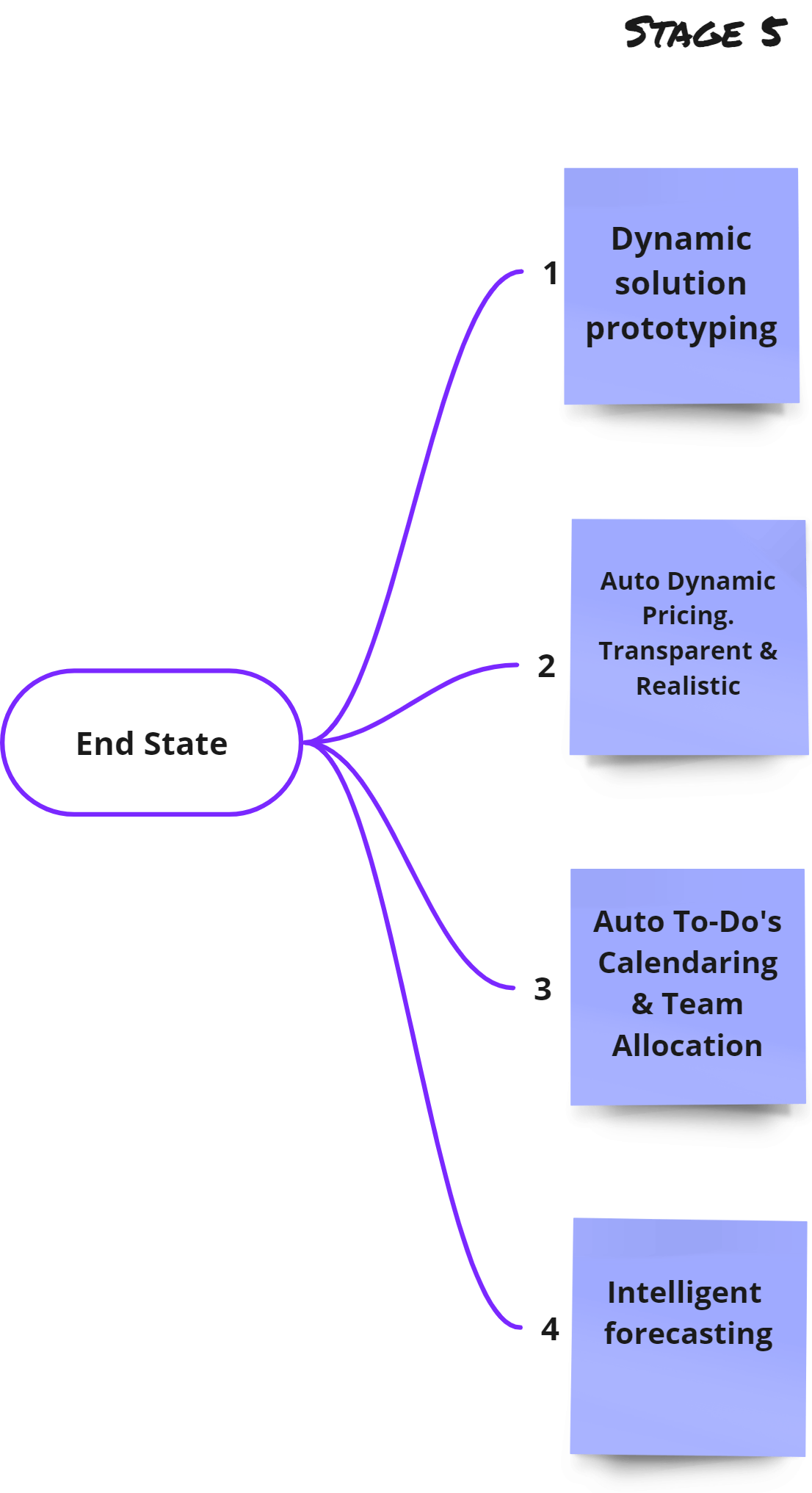
If we’ve to deconstruct the technology into multiple components and start with the end state. We are basically talking about these 4 steps (for this scenario)
Ability to do dynamic solution prototyping
Auto dynamic pricing, transparent and realistic - that can be trusted for real time decision making in front of clients
Auto to-do generator and task allocator - This will assign tasks to your team based on availability, capability and alignment
Intelligent forecasting - ML based forecasting with insight to forecast - highlight risks and ideas to improve forecast. Leverage with external signals and data models that learns and adjust based on prior forecast
Here’s how it will look like
Let’s do the next click and understand how will this flow on 5 stage process
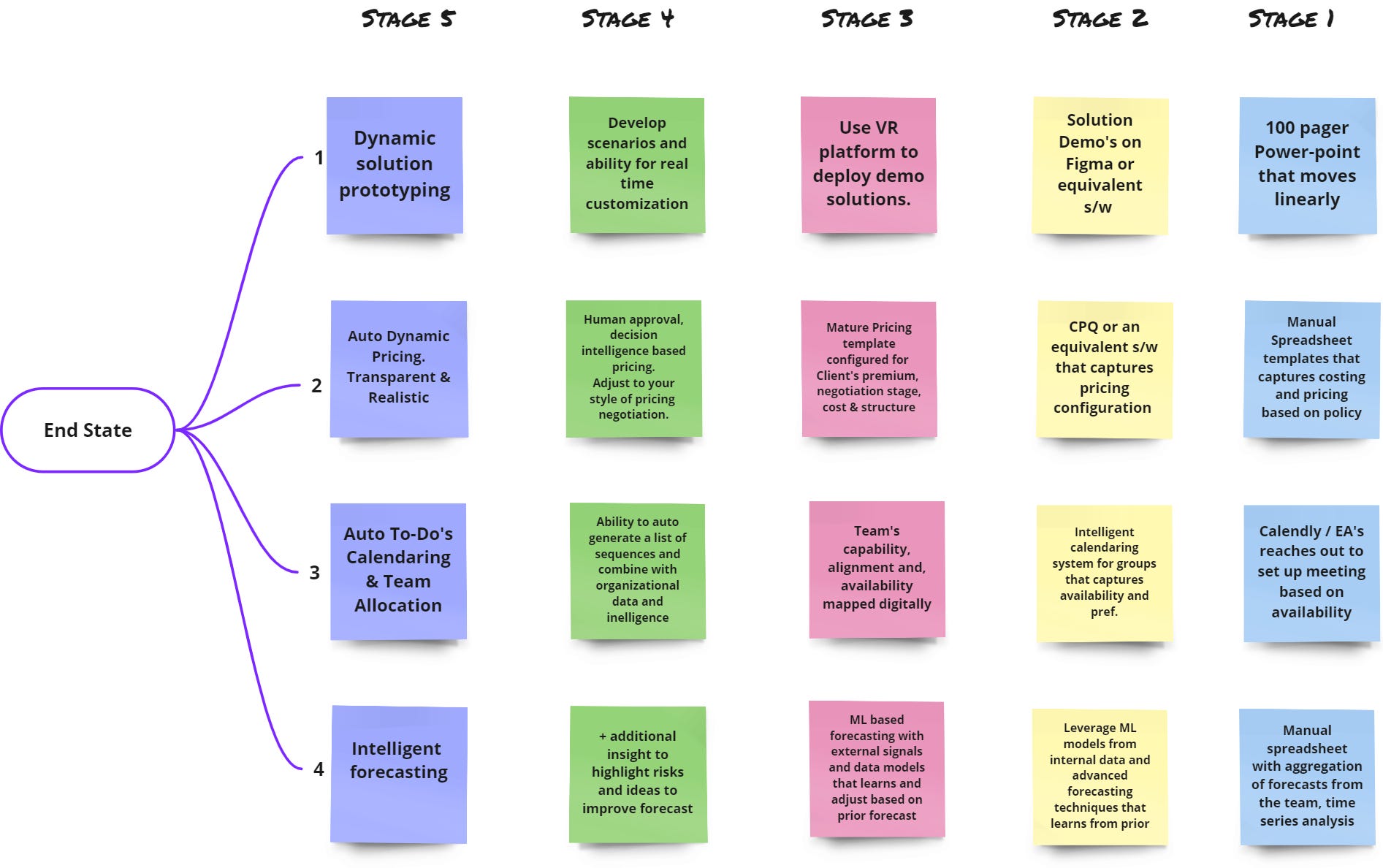
Clearly, many companies operate at level 1 or 2 and its a big leap- quite possible to make this a reality. Let me draw attention to how generative AI can impact your sales organization.
Revenue growth:
Generative AI has the potential to revolutionize the sales landscape by enabling businesses to create personalized experiences, optimize processes, and uncover valuable insights.
Mot importantly, the lead to cash visibility is now real with the power of Machine learning and LLM’s combined. You would have a comprehensive visibility of where do you lack, what capability and relationships you need to incubate, develop or capitalize upon.
Personalized marketing campaigns: Generative AI can help businesses create highly personalized marketing campaigns by analyzing customer behavior, preferences, and past interactions. It can generate unique content, promotional offers, and product recommendations tailored to each customer, resulting in higher conversion rates and customer loyalty.
Advanced real time territory management: The AI system continually analyzes market trends, sales data, and customer demographics to dynamically adjust your sales territories. You will see your team's efficiency skyrocket as they focus their efforts on high-potential areas.
Sales forecasting: By analyzing historical sales data, signals coming from email and in-call data, and external factors such as client news, market trends, and economic indicators, generative AI can help businesses generate accurate sales forecasts. This allows sales teams to better allocate resources, set realistic targets, and devise effective strategies to achieve their goals.
Lead scoring and routing: Generative AI can assess the likelihood of a lead converting into a customer by analyzing multiple data points such as demographics, behavior, and engagement. This helps sales teams prioritize their efforts on high-quality leads, resulting in increased productivity and better conversion rates.
The right leads can be routed to an efficient sales AE by using prior data on likelihood to close a particular customer segment
Sales incentive alignment - The AI system uses advanced algorithms to create personalized, data-driven incentive programs tailored to the unique needs and goals of each sales rep. These programs consider factors such as individual performance, team dynamics, market trends, and customer preferences to ensure optimal alignment between incentives and desired outcomes.
Churn prediction: By analyzing the underlying reasons for churn, the AI system can recommend targeted interventions, such as personalized offers, proactive support, or tailored communication, to address each customer's specific needs and concerns.
Dynamic pricing: Generative AI models can analyze various factors such as demand, competition, and customer preferences to dynamically adjust pricing. This helps businesses optimize pricing strategies to maximize revenue and profit margins while maintaining customer satisfaction.
Sales content generation: Generative AI can help sales teams create persuasive and engaging sales collateral, such as email templates, case studies, and product descriptions. These AI-generated materials can be tailored to individual prospects, making them more effective in driving sales conversions.
Sales co-pilots: A lot of these capabilities can be combined into a sales co-pilot . , powered by generative AI. It works alongside your sales team, offering real-time guidance, insights, and support to help them achieve their goals. Let's dive into how this futuristic sales co-pilot would make a difference:
You will observe the sales co-pilot offering real-time guidance during crucial deal negotiations and closing conversations. By analyzing historical data, customer profiles, and competitor information, the co-pilot can suggest the best strategies, tactics, and concessions to secure the deal.
How enterprises should prepare for generative AI adoption
Embracing generative AI technology can bring significant benefits to enterprises, but it's essential to be well-prepared for its adoption.
”When it comes to B2B applications, the objectives are different. Primarily, there is a cost-benefit assessment around time and quality. You either want to be able to generate better quality with the same amount of time, or generate the same quality but faster. This is where the initial translation from B2C to B2B has broken down.”
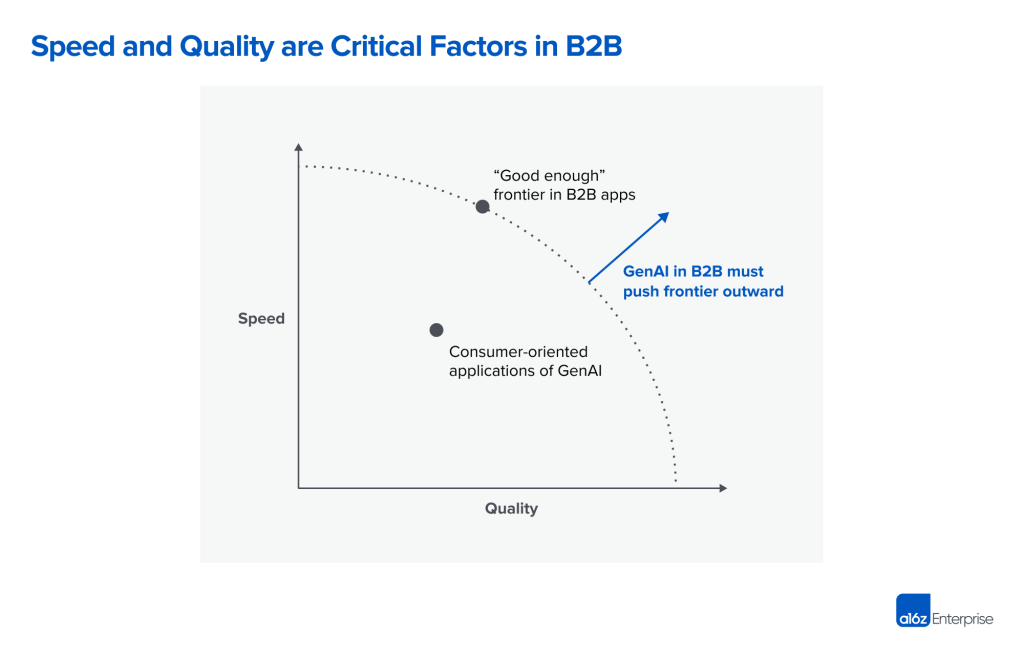
Here are some steps businesses can take to prepare for the integration of generative AI:
Develop an AI vision: Begin by identifying the specific challenges and opportunities that generative AI can address within your organization. Develop a clear vision of how AI can enhance your sales, marketing, and customer service operations, and set realistic goals and expectations. You can start with a maturity curve of stage 1-5 and map your journeys for the most critical organizational functions
Build a strong data foundation - Don’t fall into legacy 2-3 year roadmap trap: Generative AI relies heavily on data. Ensure that your organization has access to high-quality, structured data that can be used to train AI models. Invest in data infrastructure and data management solutions to improve data quality and accessibility.
These data journeys can be fast tracked these days with agile teams and new technologies.
Supercharge your workforce - make them AI ready: As AI takes on more tasks, the roles and responsibilities of your employees may change. Invest in training and create AI champions in your organization. Provide training and development opportunities to help your workforce adapt to the new technology, develop new skills, and stay competitive in the job market.
AI experts can be the torchbearer: Partner with AI startups, research institutions, or technology providers to access the latest developments in generative AI. These partnerships can help you stay updated on emerging trends and provide valuable insights to improve your AI adoption strategy.
Develop a robust AI governance framework: Address ethical, legal, and security considerations related to AI adoption. Develop guidelines for transparency, accountability, and fairness to ensure that your AI systems align with your organization's values and adhere to relevant regulations.
Start with pilot projects: Test the waters by implementing generative AI solutions in small, manageable projects. This will allow you to identify potential challenges, assess the technology's impact, and refine your approach before scaling it up across the organization.
Foster a culture of innovation: Encourage a culture that embraces experimentation, innovation, and learning from failure. This mindset will be crucial in adapting to the rapid advancements in AI and staying ahead of the competition.
By taking these steps, enterprises can effectively prepare for the adoption of generative AI and harness its full potential to drive growth and innovation.
AI startups holds an edge
This is the largest David vs Goliath moment in the history. Most of the big enterprises will move not be able to move fast enough. Partner with startups that can move nimbly according to your vision.
While large corporations have the resources to invest in generative AI technologies, small AI startups are uniquely positioned to address the challenges and deliver innovative solutions in this space.
Tldr:
AI transcends boundaries, unleashing creativity and efficiency within organizations. In just a few years, generative AI will be the backbone of innovative enterprises, disrupting industries and reshaping the way we work
Sales will transform in future - Deal cycles will be zipped by a significant factor. The technology that will drive this transformation exist today. We just need to orchestrate this into one coherent theme
Enterprises must develop a quick and agile roadmap to embrace AI. Operate at the efficient frontier of quality and speed
New and fast growing technologies such as gen AI are best understood by startups. Enterprise should work with startups to accelerate their AI vision